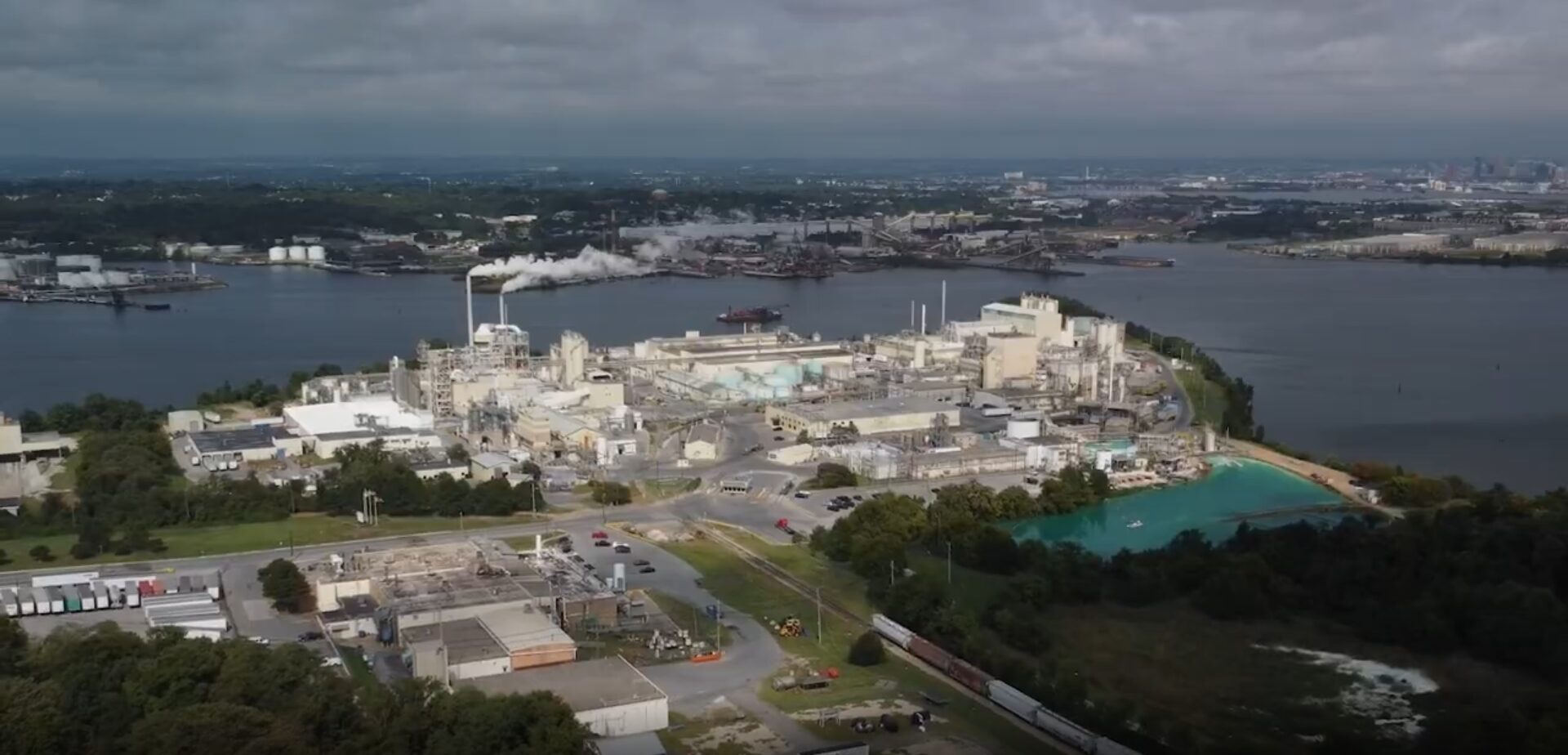
Hawkins Point
Discarded Waste, Discarded Place
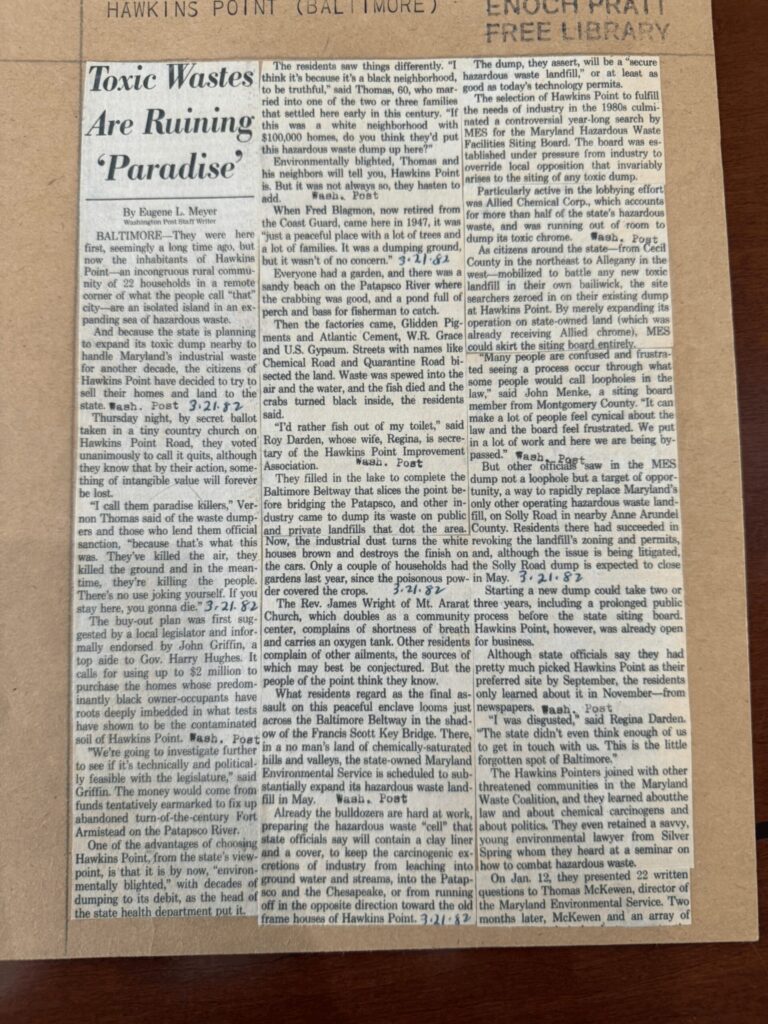
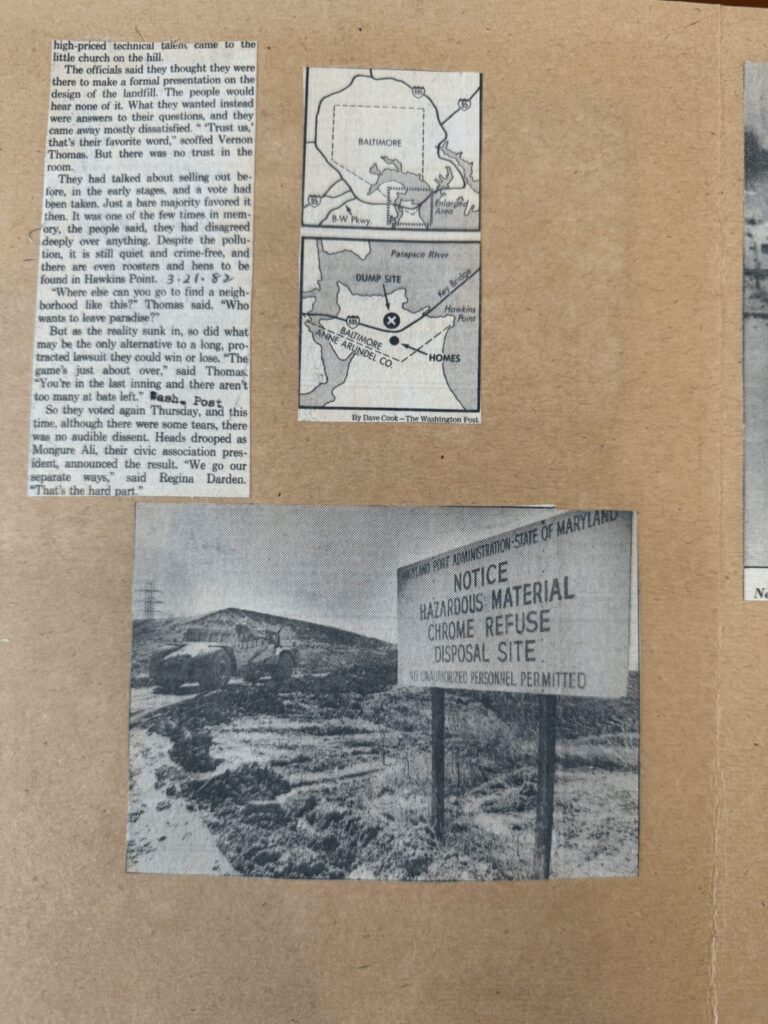
The opening film in this four-part environmental justice series tells the story of Hawkins Point. Hawkins Point, a peninsula connected to Curtis Bay by I-695, is both representative of the history of South Baltimore and a key node in Baltimore’s current waste infrastructure system. Hawkins Point was once a rural neighborhood at the edge of the city, known as a place where fruit trees and farm animals were abundant. But by 1982, the accumulations of toxic waste industry had made the neighborhood so dangerous and unhealthy that its residents chose to be bought out by the State of Maryland so they could move elsewhere. This buyout marked a turning point in which Hawkins Point was effectively reclassified from a vibrant neighborhood to a space completely dominated by waste and industry.
Hawkins Point is thus a key example, for both South Baltimore and beyond, of how municipal governments and industry treat(ed) people, particularly people of color, and places, not just debris, as waste to be disposed of.
The film traces the history of Hawkins Point and the increasing intrusion of waste industry, from the area’s use as a quarantine station for containing yellow fever in the eighteenth century to its growth as a residential neighborhood and a hub of industrial development. This choice of Hawkins Point as an area of disposal was no accident, as the neighborhood was exploited for its simultaneous proximity to and distance from the city, as well as its large number of Black residents.
Unfortunately, environmental injustices did not cease with residents’ 1982 displacement. Today, Hawkins Point is home to W.R. Grace Chemical, the Quarantine Road Landfill, the Curtis Bay Medical Waste Incinerator, and more, making the area a clear example of an industrial sacrifice zone. The story of this neighborhood stands as a testament to the dangers of industrial encroachment and the harmfulness of environmental racism.
Hawkins Point must be remembered as a rallying cry for the neighborhoods surrounding it: stop South Baltimore from becoming another Hawkins Point.
Hawkins Point is a story of both historical and present injustices. Attention is owed to the community that was once pushed out by industry. But, mostly, attention is owed to the people today who suffer the health effects of pollutants from industry in Hawkins Point. Visible emissions leak from the Curtis Bay incinerator, toxic ash from the WIN Waste Incinerator is stored in Quarantine Road Landfill, and remnants of the Key Bridge lay just off its shores. As former residents of the neighborhood have emphasized, Hawkins Point is determined to be important, both for its own sake and so that its story is never repeated again. As former residents of the neighborhood have emphasized, Hawkins Point’s importance lies in the continuity between its past and present, as the same forces that displaced residents continue to shape environmental and health outcomes in surrounding communities. Remembering Hawkins Point is therefore essential, both to acknowledge these harms and to prevent their repetition.
Additional Resources on Episode 1: Hawkins Point
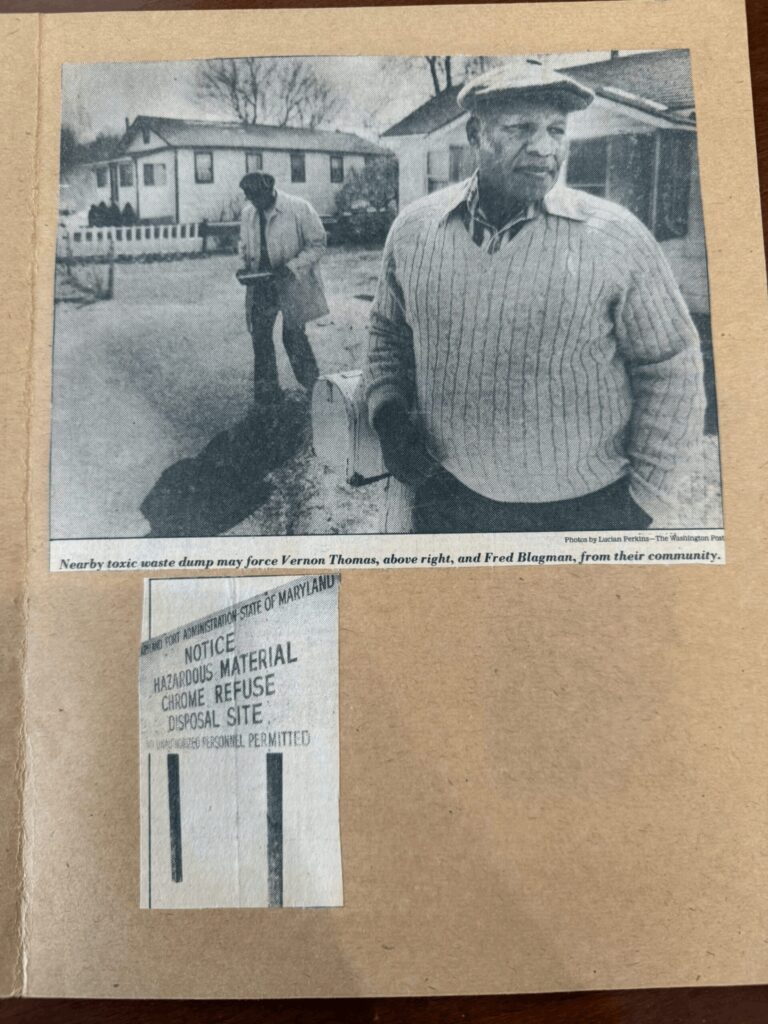
- Gilton Pitts describes Hawkins Point as “predominantly a Black neighborhood.” How did the neighborhood’s racial make-up impact how the area was treated? In what ways are environmental racism and toxic (waste) industry interconnected?
- Polluting industries are still present in the Hawkins Point area, including W.R. Grace Chemical, the Quarantine Road Landfill, and the Curtis Bay Medical Waste Incinerator. How do these toxic infrastructures continue to impact lives in South Baltimore today?
- Ahmann, Chloe. 2024. Futures after Progress: Hope and Doubt in Late Industrial Baltimore. University of Chicago Press.
- “A History of Hawkins Point and Beyond” Storyboard by Larkin Gallup https://storymaps.arcgis.com/stories/61b2bd1d0a88437b9c8e8868ab75d33d
- “City, county citizens fight industrialization: Baltimore pollution worries countians,” by Abby Karp. Article in The Sun (1837-) from August 4, 1985, p. AS2. Sourced from ProQuest Historical Newspapers: The Baltimore Sun.
- Drone footage of W.R. Grace Chemicals, the Quarantine Road Landfill, and the Curtis Bay Medical Waste Incinerator. Courtesy of Krishnan Vasudevan.
- Gallup, Larkin. 2024. “The Way We Were: Enduring Industrial Ruins and Forgotten Pasts on the Margins of Baltimore.” BA thesis. Johns Hopkins University. https://drive.google.com/drive/folders/1roKujUeENAMSRJfCn4U-XvJbM4gn_M_-.
- Hawkins Point Quarantine Station Photograph, captioned “View of the U.S. Public Health Service Station at Curtis Creek in 1932. To most people, it was known as ‘Quarantine.’” Courtesy of the Enoch Pratt Maryland Room.
- “Hawkins Point dump, once wanted so badly, will fold,” by Tom Horton. Article in The Sun (1837-) from April 13, 1984, p. E1. Sourced from ProQuest Historical Newspapers: The Baltimore Sun.
- “I Remember…When Ships Came in to ‘Quarantine,’” by Milton H. Chojnowski. Article in the Sunday Sun Magazine from August 11, 1963. Courtesy of the Enoch Pratt Maryland Room.
- Map from “Dump plan stirs dispute” by Michael K. Burns and Michael J. Clark. Article in The Sun (1837-) from November 3, 1981. Courtesy of the Enoch Pratt Maryland Room.
- Maryland Historical Trust Inventory Form for State Historic Sites Survey. 1976. Courtesy of Larkin Gallup.
- Map of Industrially Developable Land in Hawkins Point. Page 25 of “Hawkins Point Sector: Baltimore City Harbor Opportunities Plan” by Neil Curran, Chief, Economic Analysis Section, Baltimore City Department of Planning, February 13, 1977. Courtesy of the collections and archives at the Baltimore Museum of Industry.
- Map of “Land Use” in Hawkins Point. Page 16 of “Hawkins Point Sector: Baltimore City Harbor Opportunities Plan” by Neil Curran, Chief, Economic Analysis Section, Baltimore City Department of Planning, February 13, 1977. Courtesy of the collections and archives at the Baltimore Museum of Industry.
- Map of Hawkins Point and SCM Chemicals HPP Landfill. Courtesy of Minnie’s Suitcase.
- Map of “Hawkins Point and Environs.” Page 6 of “Hawkins Point Sector: Baltimore City Harbor Opportunities Plan” by Neil Curran, Chief, Economic Analysis Section, Baltimore City Department of Planning, February 13, 1977. Courtesy of the collections and archives at the Baltimore Museum of Industry.
- Map of the “Major Firms” in Hawkins Point. Page 15 of “Hawkins Point Sector: Baltimore City Harbor Opportunities Plan” by Neil Curran, Chief, Economic Analysis Section, Baltimore City Department of Planning, February 13, 1977. Courtesy of the collections and archives at the Baltimore Museum of Industry.
- “Neighbors of landfill to move,” by Michael K Burns. Article in The Sun (1837-) from March 22, 1982, p. D1. Sourced from ProQuest Historical Newspapers: The Baltimore Sun.
- “Neighbors in Hawkins Point get together one last time,” by David Brown. Article in
- The Sun (1837-) from August 15, 1982, p. C1. Sourced from ProQuest Historical Newspapers: The Baltimore Sun.
- “NEWS OF THE PORT.” Article in The Sun (1837-) from October 31, 1894, p. 6. Sourced from ProQuest Historical Newspapers: The Baltimore Sun.
- South Baltimore Community Land Trust. 2024. “Complaint Under Title VI of the Civil Rights Act of 1964 against the City of Baltimore.”
- “Toxic dump site already disturbed by contamination,” by Mary Knudson. Article in The Sun (1837-) from November 15, 1981, p. B1. Sourced from ProQuest Historical Newspapers: The Baltimore Sun.
- “Toxic Wastes Are Ruining ‘Paradise’; Hawkins Point: ‘They’ve Killed the Air, They Killed the Ground,’” by Eugene L. Meyer, Washington Post Staff Writer. Article in The Washington Post (1974-) from March 21, 1982, p. B1. Sourced from ProQuest Historical Newspapers: The Baltimore Sun.
- WJZ-TV, August 8th, 1982. Mid-Atlantic Regional Moving Image Archive Repository. https://marmia.libraryhost.com/repositories/2/archival_objects/13206. https://archive.org/details/WJZ-EYE-031-019.
- W-MAR-2 News, October 17, 2023 “‘Environmental injustice’ in Curtis Bay.” https://www.youtube.com/watch?v=qc0I6sajSvw
- WBAL-TV 11 Baltimore, October 17, 2023. “Protests over Curtis Bay Medical Waste Incinerator.” https://www.youtube.com/watch?v=ioLmrytQZEA
- 1853 Chappell Fertilizer Advertisement. Courtesy of Larkin Gallup.