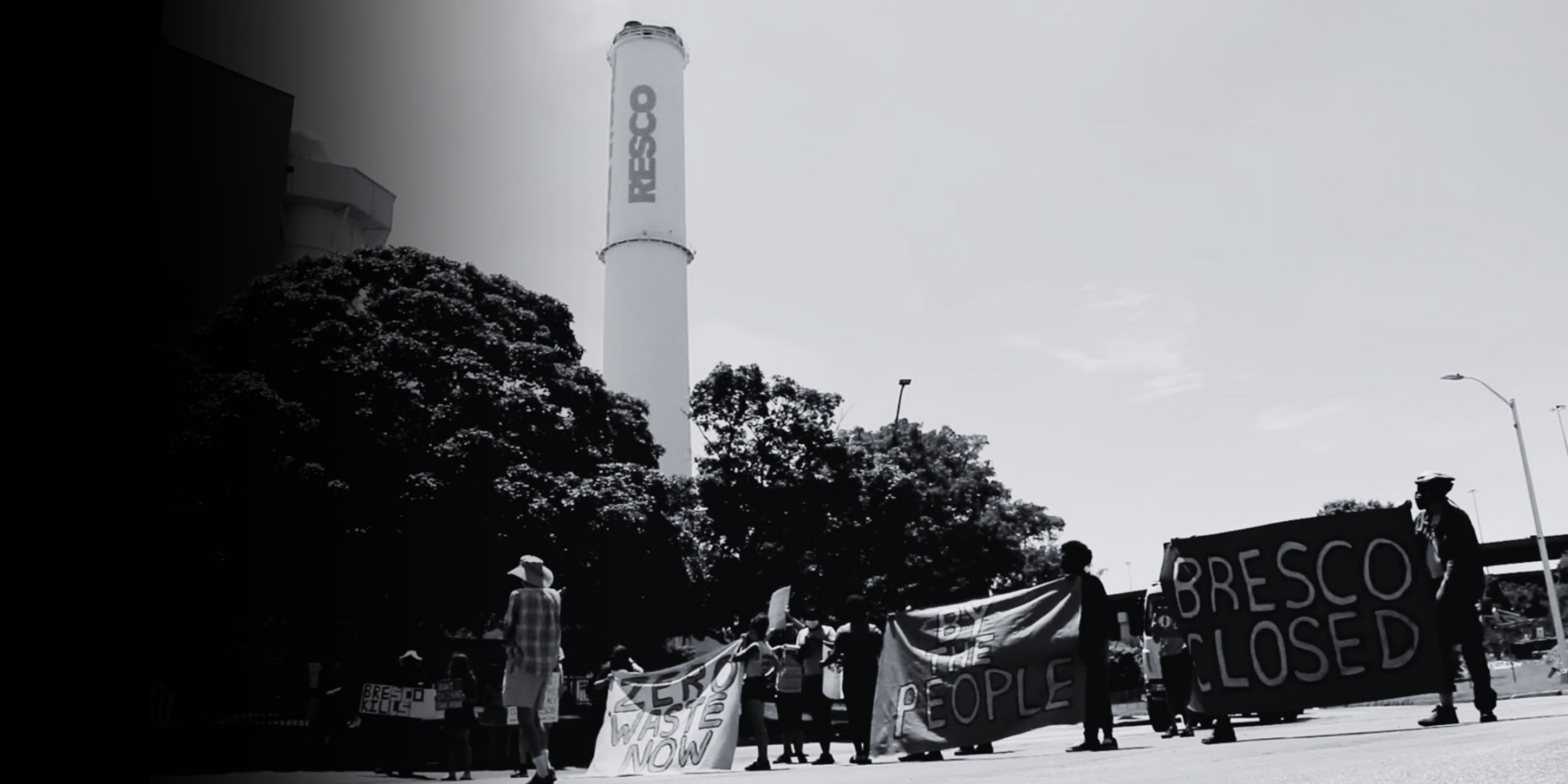
On Thursday, October 1, the Maryland Department of the Environment (MDE) held their public hearing on permit renewals for the BRESCO incinerator, also known as WIN Waste or Wheelabrator. Here are 7 moments from the hearing you don’t want to miss.
1. Momentum & energy in a packed room
The energy was palpable. People showed up! There were around 175 people in the room at the start of public testimonies, with 55 more attending online. People sat on the floor and lined the hallway.
Simmering in the air was MDE’s announcement that day that they were forcing Curtis Bay Energy to close. Curtis Bay Energy, the country’s largest medical waste incinerator, has a long history of criminal violations. The closure of Curtis Bay Energy happened because we the community became watchdogs when the government wouldn’t. We monitored and documented the incinerator’s violations, even when MDE didn’t believe us, because we knew what was happening in our South Baltimore communities. Through our community-led research efforts, we forced the state to take action back in 2023, we pushed institutions like Hopkins to divest from the incinerator in 2024, and now the state has shut Curtis Bay Energy down for good.
Going into the BRESCO incinerator hearing the same day as the medical waste incinerator shutdown, we knew what community can do. We’d seen the results earlier that day. And we were eager to do it again.
2. Collective action, collective power
We were organized and coordinated. Each person who signed up to give testimony at the hearing was allotted two minutes to speak. One after another, residents went to the mic and said:
“I am concerned about the impacts of BRESCO ash on our health. Deny the permit. I yield the remainder of my time to Shashawnda.”
This was a strategic collective action to allow one longer, unified testimony from Shashawnda, SBCLT’s Environmental Justice Director, who would outline the community’s primary concerns. By our count, 48 people yield their time to Shashawnda.
Many people who completed their testimonies urging the denial of the permit joined a chain of linked arms around the room, displaying a united front to MDE.
3. WIN Waste lies
Later in the hearing, a WIN Waste representative came to the microphone and claimed that the ash generated by the incinerator is “non-hazardous and non-toxic.”
This claim is false based on a 2014 MDE memo written by an MDE toxicologist that warns that the ash contains levels of dioxin that are 24 times the EPA level used to assess cancer risk in soils. (SBCLT was able to obtain this memo via a Maryland Public Information Act request.)
The representative further claimed that “The available scientific evidence indicates the emissions from the facility have a negligible impact on Baltimore City’s overall air quality.” As recently as 2025, researchers from the University of Maryland have identified that BRESCO “continues to be the single largest source of harmful emissions in the city” based on public emissions records.
At the outset of these lies, the chain of community members who had linked arms turned around, signaling their refusal to lend credence to anti-science claims that prop up industry and harm public health.
4. Personal stories of harmful impact
Throughout the evening, we heard powerful testimonies from local residents who shared stories of loved ones who died because of asthma, cancers, and lung diseases caused by known pollutants from the BRESCO incinerator. “My husband on a hot August summer night died of an asthma attack that led to a heart attack,” shared Ellen Barfield. “You are killing people.”
A resident named Abby called out that 20% of students in Baltimore City have asthma, while the national average is only 9%. As John Garofalo put it, “We are living with the impacts of the negligence and dereliction of duties of MDE every day.
5. Did MDE follow their own process?
Several testimonies questioned MDE’s process for public comment and the ways MDE did not follow their own process requirements.
Jennifer Kunze of Clean Water Action opened her testimony with, “I’d like to talk about problems in the water permit for BRESCO, but I can’t. And that’s because the water permit was not available online for public review until Monday of this week, the 28th, and it did not become available until colleagues of mine pointed out that it wasn’t online.”
Furthermore, because MDE issued a tentative permit to BRESCO before sending out the public notice they were required to send, the community was unable to request an informational meeting before the tentative permit was issued.
Jennifer also identified areas where the permit does not take into account new regulations from the EPA and the state of Maryland. For example, “MDE is authorized now to require continuous emissions monitoring for pollutants like mercury that have a really big impact on public health. Why isn’t that in the permit?” she questioned.
Carlos Sanchez, SBCLT’s Youth Organizing Specialist, took issue with MDE’s lack of transparency around the entire permitting process. “Our communities have lived next to this facility for decades,” he said. “We deserve more than assurances that everything is safe. We deserve independent evidence, transparency, and protection that allows us to actually know what we are being exposed to.”
6. Three important questions met with dead silence
During her testimony, Angela Smothers, lifelong Mt. Winans resident, brought out five important texts: the Bible, the Federal Clean Air Act, Maryland’s Environmental Justice Law, our community’s federal Title VI civil rights complaint against the ongoing operation of an incinerator that is harming us, and the permit application that was being considered at the hearing.
These five texts, she said, “represent the moral and legal responsibilities that are intended to ensure that no community is treated unfairly or harmed by decisions by our own government.”
She called on MDE officials to place their hands on these documents and answer the following questions as an oath of accountability:
First community question: Is incinerator ash from BRESCO safe for us to breathe in any amount?
Second community question: Is it safe to have any level of incinerator ash in our yards or in our homes?
Third community question: Is incinerator ash always being transported safely through our communities and handled safely at the landfills in Baltimore City and County?
The silence from MDE after each question was deafening.
7. The community’s demands are clear
Finally, Shashawnda brought down the house with her closing testimony. In it, she reiterated the community concerns regarding ash composition and the permitting process that others had referenced already that evening.
Shashawnda made the community’s demands clear:
- We need an ash sample.
- MDE should pause the permitting process until an ash sample is studied so we can understand its impacts on our health.
“We are asking you to give us the evidence so we can examine it for ourselves,” explained Shashawnda. “Without the sample, how can we test it? How can we actually know the severity of what is happening to our health?”
The permitting process is not legitimate until we have these answers.
Shashawnda asked those in the room to raise their hands if they are “calling for this Title V permit to be denied because of concerns about the facility and pollution and calling for this permit process to stop until questions are answered about the ash and the sample is handled over.”
Hands shot up all around the room and remained up until Shashawnda closed the meeting for the community. “Now I adjourn this permit hearing for the people. We may go.”
There’s still time to add your name to our collective letter.
The Maryland Department of the Environment is currently taking public comment on the air pollution permit renewal for the BRESCO incinerator. Written comments are being received through Thursday, October 8, 2026.
Please consider submitting your own written comments for the public record by emailing Ms. Shannon Heafey, MDE’s Title V Coordinator, at sh************@******nd.gov.
Please also sign onto this collective letter so we can demonstrate our cohesive, collective, organized public support to MDE. The deadline to sign onto this letter is noon on Thursday, October 8. We will compile all signatures and submit to MDE on Thursday, October 8.